
My firsthand experience using '5 Wishes' to talk about end of life
Complete with how-to screenshots of 2 online tools

Welcome to I’m Not Gaslighting You, a series about medical gaslighting and healthcare inequality from the perspective of a medical sociologist who also happens to be a real woman in an actual body.
🎤 Please DM me to let me know your questions or topics you would like to see me cover. I’m always on the lookout for prompts.
👀 Let’s be friends on Instagram, where I post about research & end-of-life topics.
______________________
It’s come to my attention that I give this one piece of advice all the time that may not be fully helpful to people, so let’s unpack it a bit and rectify this situation.
Said advice goes something like this:
Oh, not sure how to talk with your family about these end-of-life topics? I get it’s really difficult. But there are some wonderful online resources that are design to help. Try 5 Wishes or The Conversation Project.
Then I hear nothing and assume that people are able to take the next steps. I imagine they are all out there using these materials and having all sorts of success. It’s kind of like teaching college students, where you get crickets and that could mean all is well, or it could mean everyone is confused and no one wants to speak up.

But recently a friend called and asked if we could talk about a family situation where they were experiencing a lot of frustration and pain. One family member was getting close to end-of-life, and was not wanting to have more treatment. Their spouse was extremely upset about this, and my friend was hoping to facilitate some conversation.
I shared the usual resources. But as I talked with my friend, I realized that it was hard for him to envision what these resources were and how he could use them. I ended up reading sections of the worksheet over the phone to paint a picture.
Afterward, I realized it might help you to see this worked out visually here—and to hear from someone who had a successful experience doing 5 Wishes with her family.

First: A quick overview of 2 tools.
The Conversation Project is a not-for-profit collaboration with the Institute for Healthcare Improvement. They have been working together since 2011.
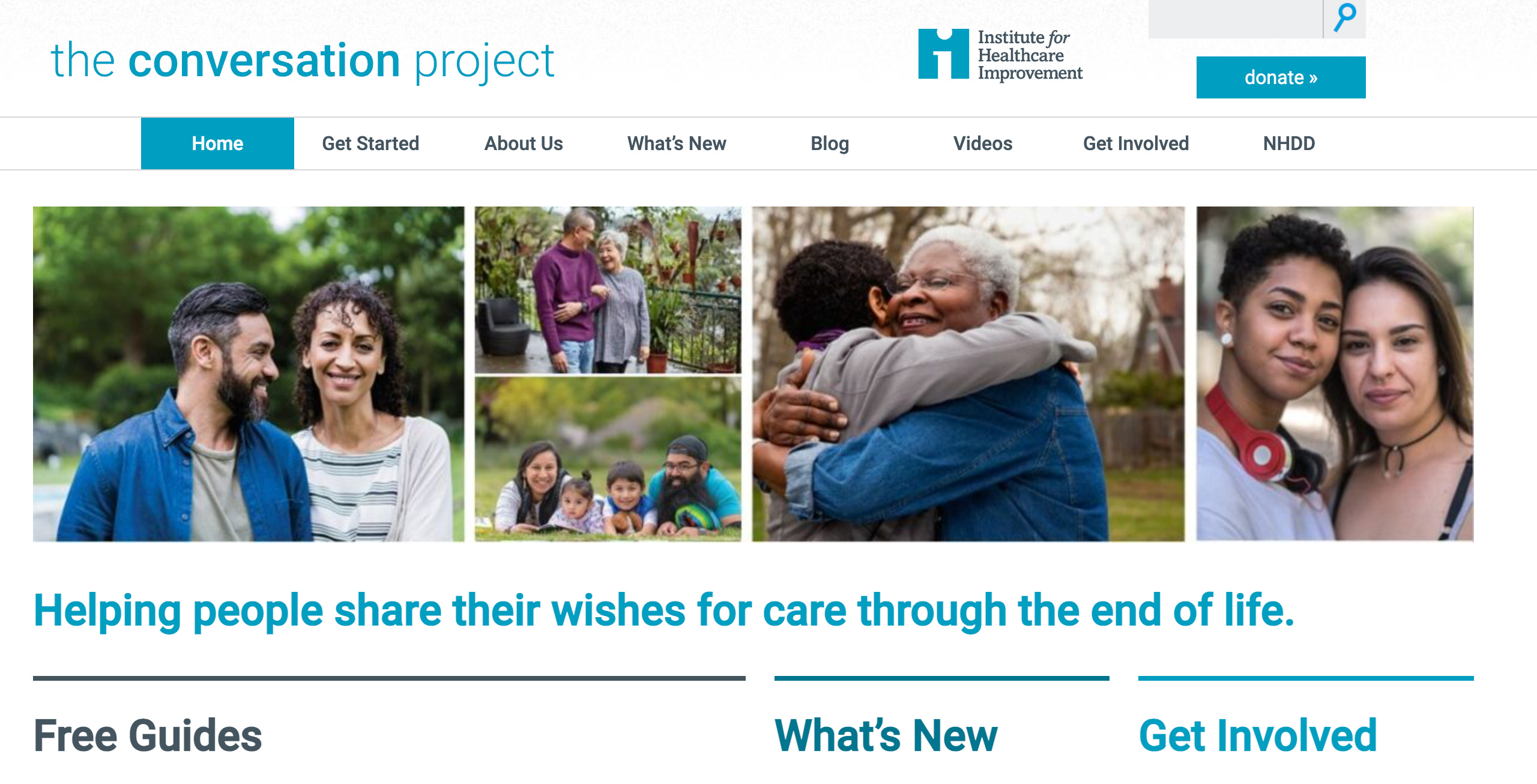
Some things I like about TCP include:
It’s research-based (check out resources here)
Their conversation starter guide is FREE
It’s available as a PDF here
I also like the content, especially if you think someone is needing a conversation about various end-of-life healthcare services— think palliative care or hospice. TCP backs into those specific topics in ways that are completely aligned with everything I have learned in my research with palliative care providers.
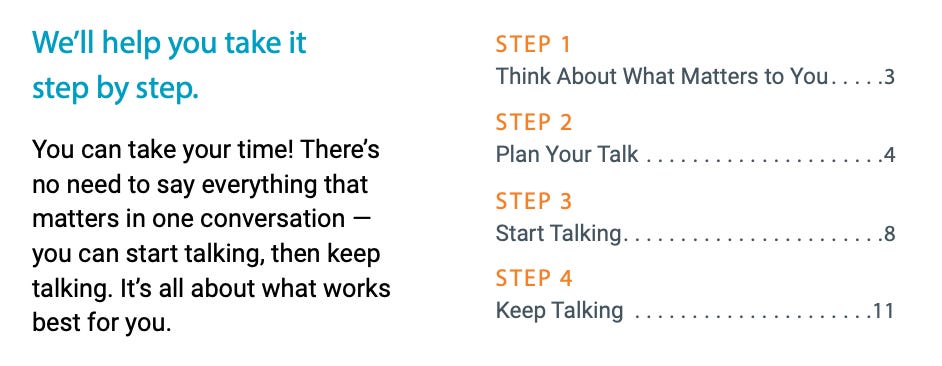
TCP’s starter guide is organized around these 4 steps. I think it’s powerful to acknowledge that these conversations often do not happen in one fell swoop but take time.
Then, as you get further into the guide, the pages look like worksheets you can fill out. Here is the page for Step 1 (the other steps are longer but have a similar format).
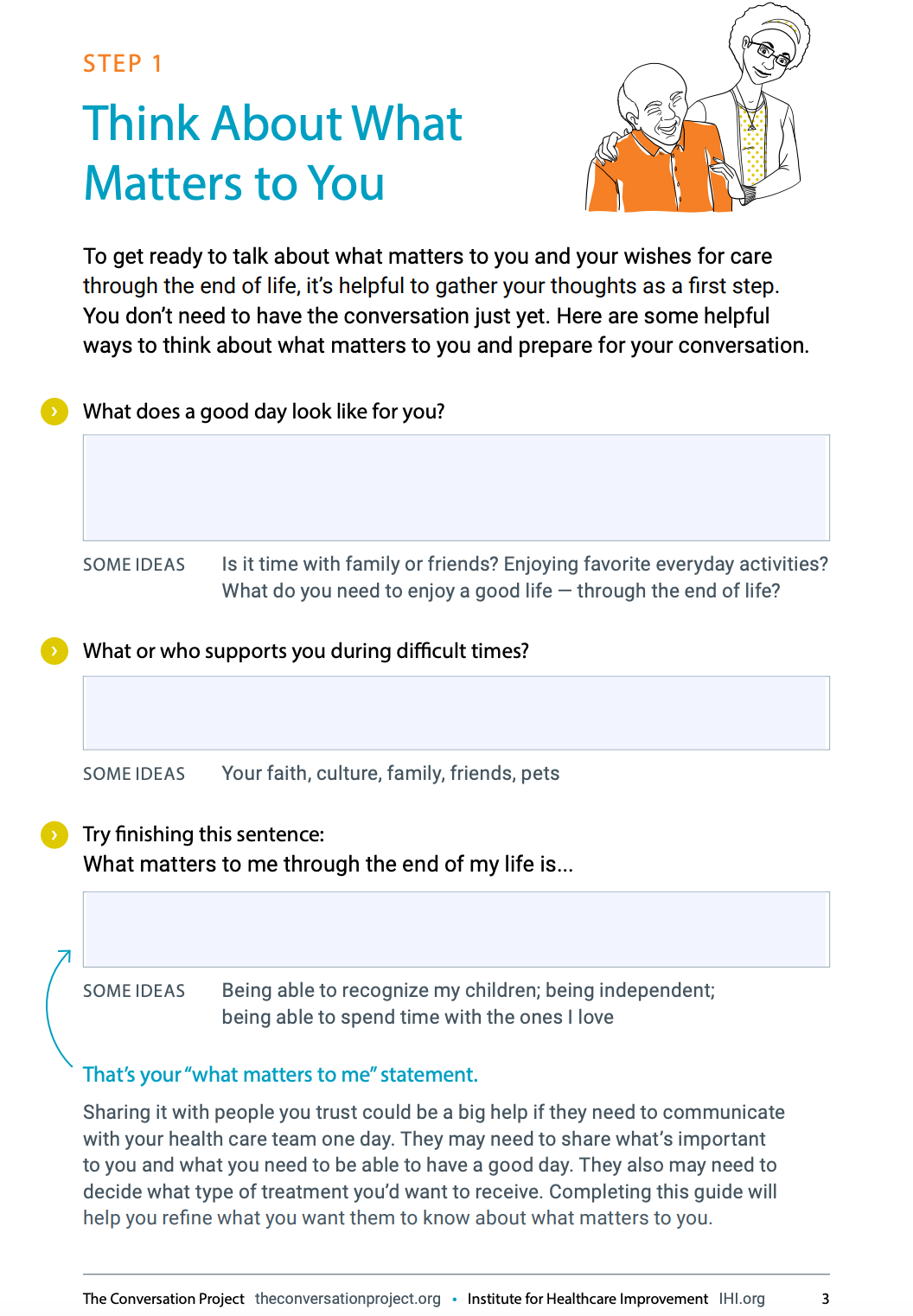
I like how we are encouraged by TCP to gather our thoughts beforehand (because no one wants to be bombarded in this situation), and also think about what a good day looks like right now. In my research, I find that people have trouble thinking about quality of life in terms something other than whether or not they would want to be on a ventilator. Often, the keys to thinking about these topics are things that you might be doing right now, while you read this. Drinking coffee? At home? With someone you care about? TCP gives you permission to see quality on those terms, and helps you share that perspective with people who might be caring for you.
5 Wishes was established in 1998 and stems from the non-profit organization Aging with Dignity. They characterize themselves as the “first advance care plan (ACP) to address personal, emotional, and spiritual wishes, in addition to medical treatment.”
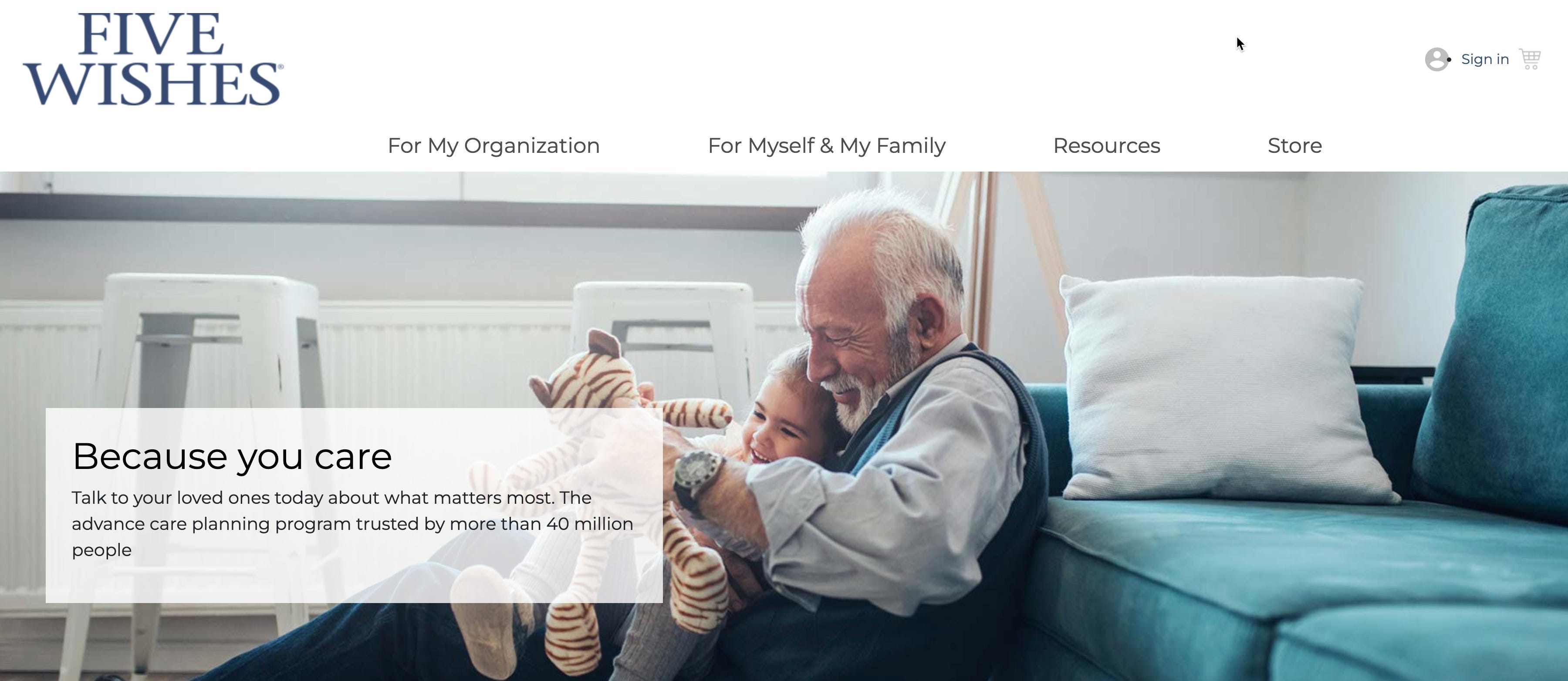
What are the 5 wishes you discuss?:
The person I want to make care decisions for me when I can’t
The kind of medical treatment I want or don’t want
How comfortable I want to be
How I want people to treat me
What I want my loved ones to know
5 Wishes also has a great YouTube video here if you have more questions:

Some things I like about 5 Wishes include:
5 Wishes is designed to serve as an advance directive. They sought input from the American Bar Association and have information for each state in the US; it has been translated into 30 languages.
This means that 5 Wishes can generate a legal document that you can upload and use in place of outdated documents you want to replace.
The trade-off is that, unlike TCP, which is free online, you can see a free sample PDF online for 5 Wishes but need to pay to have a digital ($7.50) or paper ($5) version (with discounts for volume).
I think these are great for families that want to talk about these topics generally and need an ice-breaker, but would maybe go toward TCP if there was more immediate questions about whether to seek end-of-life services.
Second: Does it even work?
So what about my friend who called asking for advice? My understanding is that these tools didn’t do much to change things when he tried to engage with his family. I know another person who has been trying to start EOL conversations with her family, and no one will engage with her either. That’s FINE and NORMAL, if frustrating.
These tools are not magic bullets, and I definitely get that. In the big picture, though, I think they are so much better than having nothing to help support and guide these difficult conversations.
It’s difficult when people are getting close to dying. These are hard topics to cover even when everyone is alive and well. Everyone has different emotions, perspectives, histories, and ideas about how this “should” unfold.
Third: Enter Jan! She did 5 Wishes with her family while they were all healthy and tells us about what worked and what advice she has.
Hi Jan! Thanks for sharing your experience. Can you tell us why you wanted to try 5 Wishes and what you did?
I used this tool with my mom and dad. At the time when we went through it, they were both in their mid-seventies, both retired, still living independently in the house I grew up in, still going to church every Sunday in the congregation where both of their daughters were married. They are both in good health, no chronic conditions, and no indication that we’ll need to honor their Five Wishes anytime soon.
My husband and I were caregivers for my mother-in-law in our home for the last 2 years of her life, and as you might imagine, that experience gave me A LOT to think about regarding my own parents: what the end of their lives might look like for them, and what their ends might look like for me, as the first-born daughter. I know it got them thinking about it as well, as they witnessed my experience, and they served as a support system for me and my husband. At the same time, my dad was watching HIS parents work through their own end-of-life decision-making. All of this is to say, my parents and I (and my sister) were predisposed to have this conversation.
I learned about the Five Wishes program from an elder law attorney who was helping with a will for my mother-in-law. Working through the booklet seemed to be standard practice for her, and it was really helpful in our conversation about the will, it was a nice way to ease into the task at hand.
About a month after my mother-in-law died, I ordered a set of Five Wishes booklets from the company, and I started handing them out to family members. I had told my parents about the program when we did it with my mother-in-law, so they were familiar. And they were completely on board when I gave them the booklets and said, “Go through this, together or separate, and let me know when you are done.”
How did it go?
It was probably a month later when they told me their homework was complete, and it was time for a family meeting, just the four of us. We got together on a Sunday afternoon and sat around their kitchen table to see what they wrote. They each completed their booklets separately, which I thought was nice, so each could really be true to their OWN wishes.
Wishes 1 and 2 and 5 were easy to work through. They had completed living wills and DNRs years ago, so we already knew about their medical treatment decisions. It was interesting that they had different answers about life support for themselves, and that generated some conversation. One of them is firmly not wanting life support, and one of them wants it if a doctor believes it will help. The second parent was almost apologetic about expressing this wish, and we assured them that this was THEIR decision, and we would honor it without hesitation and without judgment.
When we got to Wishes 3 and 4, though, about comfort measures and how to be treated, this is where things got a little uncomfortable. It was clear that neither of them had thought much about what their end-of-life, pre-death days might be like.
My mom almost enjoyed the Wish 3 list, remarking that many items sounded “really nice.” I think it was reassuring to her know that someone would attend to her comfort in these ways when she could no longer do that for herself. From my dad in this section, we learned that he is emphatically NOT INTERESTED in warm oils, or any kind of massage, for comfort; we had a good laugh about the intensity of his feelings on this topic.
In fact, we had a lot of laughs, and we also had tears.
We talked about both sets of grandparents and what happened at the end of their lives. We talked about my experience with my mother-in-law: what I had learned, what I would have done differently, what I WILL do differently should I find myself providing that level of care for my own mom and dad.
I would give my parents each an A for their assignments. They clearly gave the exercise care and thought, and their requests are all easy to fulfill. My mom was ready to fight for having “Boomer Sooner” played at the end of her service, but we told her, no problem, we’ll find a recording. If that’s what she wants, that’s what she will have. It will be our privilege to honor their Five Wishes, and I’m grateful to know what they are!
What made it go well? What advice would you give people starting this process?
When I was growing up, I assumed everyone had a family like mine: close, communicative, supportive, loving. I’ve come to realize that we are an exception, and I’m so thankful for that exception. This conversation was made infinitely easier by the fact that we are so close, and that we are all confident in the love, and intentions, we have for each other.
I recognize that these will not be the conditions that exist for everyone who wants to use this tool with their loved ones. In fact, I am currently a caregiver for my mom’s brother and sister (in their early eighties, and NOT in the best of health), and while I would like to go through this program with each of them, we’re just not there yet in our relationships.
My advice for others is: do it when your loved one is healthy, when the need isn’t imminent. When we talked about these wishes with my mother-in-law, it was really too late because we were IN IT, and I think that made it difficult for her to be truly honest about what she wanted.
I definitely recommend having your loved one go through the booklet first on their own, collect their thoughts, and then talk with you.
And acknowledge that this is a gift for both of you: you are giving your loved one the gift of a promise to honor their wishes to the best of your ability, and they are giving you the gift of not having to guess, not having to worry about making a wrong decision.
We did not take the extra steps of having witnesses sign or uploading the document to the Five Wishes site or making copies for their doctor. For us, we all felt it was sufficient to have had the conversation, to have one copy of the documents, and to commit to keeping the lines of communication open as the years come and go.
Their Five Wishes are tucked away, and I hope to not need to look at them for quite awhile yet.
p.s. Soon after I published this, I discovered this piece in The New York Times, “5 Conversations to Have with Your Aging Parents”— perhaps of interest.
End Notes (back to Karen 😊)
What are you listening to? I’m not a huge podcast listener, but I can’t get enough of Anderson Cooper’s podcast All There Is. He did an episode with Nick Cave in December and it’s just exquisite. If you feel alone in grief, or you just want to listen to a human being interviewing people about being human, try it out.
What are you reading? I recently discovered the author Katie Kitamura, and I devoured A Separation, Intimacies, and Audition in short succession— kind of like not being able to stop with a bag of Doritos, but at the end, instead of feeling gross, you still want more. And you want to be able to write as beautifully.
Where are you hanging out? Last week I went to a book signing for Meghan Rabbitt’s new book, The New Rules of Women’s Health. I’m admittedly biased because I met Meghan when she interviewed me as an expert for this book. It’s like an updated Our Bodies, Ourselves. There was standing room only at her signing, and the conversation was super-smart. 10/10 no notes! Relevant for women of all ages and the people who care about their health.


There is an implied, "I know you'll do the right thing by me in EOL, because you are in public health/healthcare" with my family. I appreciate the resources, and think it will make those conversations I have attempted to start with loved ones more manageable. Also-- can't wait to get my copy of The New Rules of Women's Health!
Hi Kate, Great article! I wasn't familiar with your work so I did a little Google-ing;-) Although when one caregiver sees another who's been on more than one rollercoaster, there's almost an unspoken trust and bond.
Thanks for laying out the 5 wishes, sharing your experience, and providing the links. I'm based in the UK, but I passed these on to a few people around the same time I discovered that 'End of Life Doulas' existed (thank you, Jodi Picoult, for 'The Book of Two Ways'!).
I'm looking forward to reading your next articles and book.
May I link to this article for my readers? I curate anthologies for my publication Carer Mentor for caregivers to have a dynamic hub of resources and tools, somewhere they can receive heartfelt empathy and inspiration. Thanks. Victoria