

Do you trust your narrators without personal stories?
A convo with death doula extraordinaire, Jane Callahan!

A death doula and a sociologist walk into a bar…
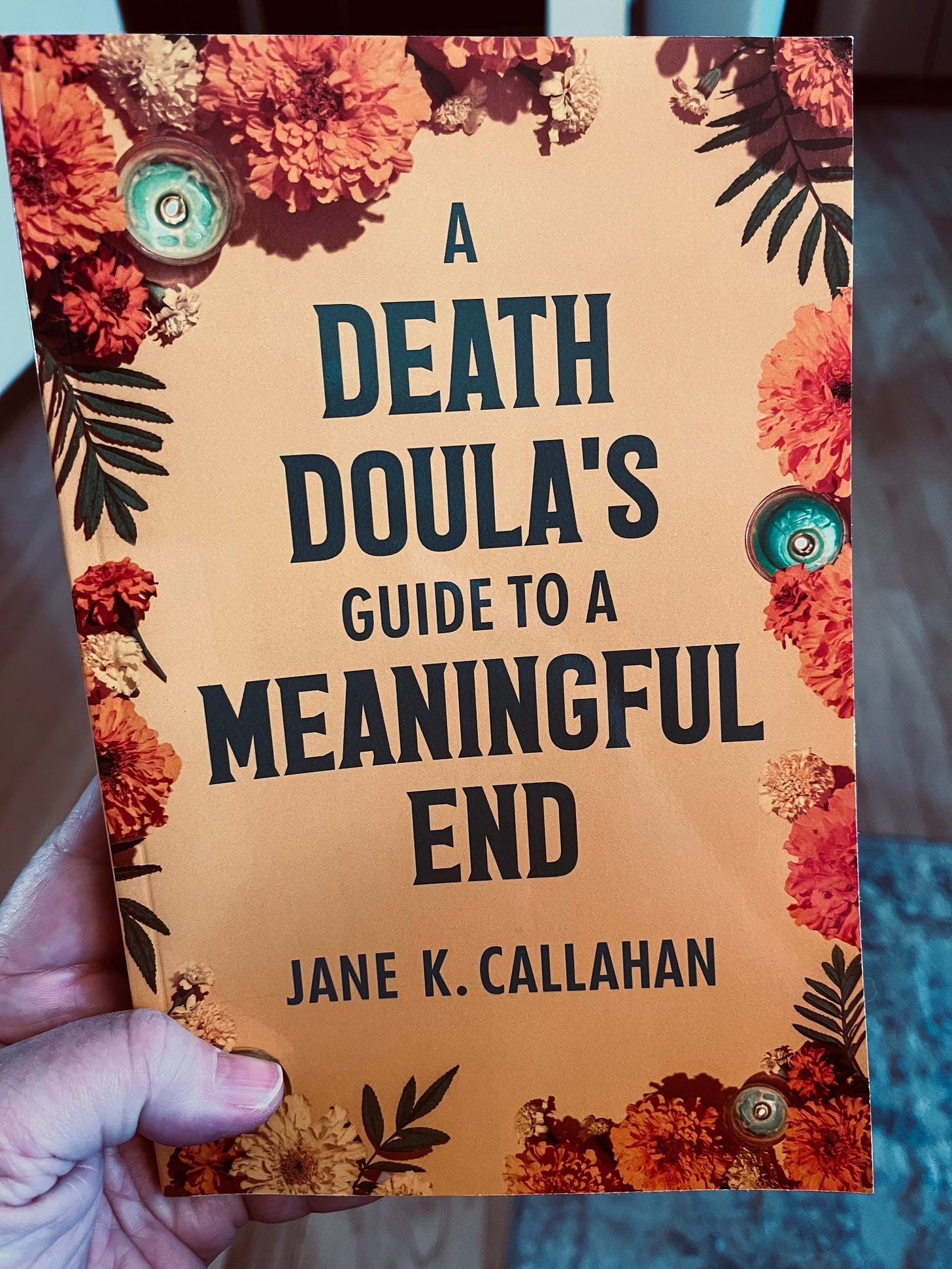
If you’re not already familiar with her work, Jane Callahan is a death doula, author, and studying to be a clinical mental health provider. Jane writes a great column here on Substack called The Terminal where she publishes “sassy rants,” expert Q&As, and fantastic compilations of new articles related to end of life.
Jane also had a new book out this spring! A Death Doula’s Guide to a Meaningful End is a top favorite in my reading pile this year— you can read more of my review at the end of this essay. But 10/10 I love it and recommend it, no notes.
Earlier this year, Jane and I moved off Instagram and started having zoom calls and emails and other off-line conversations. We collaborated on this piece in The Conversation about palliative care and doulas as important but underutilized tools in end of life care:

Of course, when you write something like that, there are a lot of loose threads that end up on the cutting room floor, so I invited Jane to continue some of that conversation here.
Karen:
One aspect of your book that I find very compelling is how effectively you interweave your personal experiences with stories about dying people you have worked with, and then use all of that to leverage larger analytic points you make about how to have a meaningful end of life.
You are so generous with telling us your personal stories. You write about your mom, your experience giving birth, and you tell a particularly harrowing story about a near-death experience in the river with your family.
But I can imagine another version of this book where you didn’t put yourself out there with these stories. You have been working as a doula for a decade, worked with several hospices in multiple states, you have a master’s degree and are currently working on another master’s in clinical counseling. You could have relied on your professional experiences and just stood as an expert. Why not do that?
Jane:
I did that for a few reasons. First, when I got my masters degree in English (creative writing) years ago, I wrote a thesis about my summer living and working on a commune in the middle-of-nowhere as a girl from Brooklyn who had never so much as planted a potato before.
In my mind, I wanted to go into this commune as a reporter--I didn’t want my own pre-formed opinions about, you know, a naked dance party in a field to be the center of this thesis; I wanted to provide an objective account so that the reader could come to conclusions on their own. And overwhelmingly the feedback from all my readers was, “This is great, and, I found myself wanting to know so much more about you, and that just wasn’t there.” I found that odd, since this was about the commune and not me, but it helped me realize that readers want to deeply know their narrators. And when you’re narrating a story about something else, it absolutely does involve you. And you, the narrator, must be trustworthy. And there is no trust without an exchange of personhood between the writer and the reader. It’s like watching a TV show where you don’t actually like the protagonist; if there’s no deeper connection there, everything else won’t land.
The second reason is because this is a big topic and I wanted to make it clear that this is what I have learned, what I have seen, what I have felt and thought, and that I don’t speak for everyone in this space. I had no intention of telling readers how they should live or die--only that this is what I have come to know.
Finally, one of the messages in this book is asking people to be vulnerable and brave in exploring topics that may be painful or uncomfortable to them. If I could do that first—show my humanity, my flaws, my hopes—then maybe it would give readers a little more of a boost to do the same. It is proof that stuff happens to all of us, not just death. And maybe what happened to me didn’t happen to you exactly, but I felt confident most people could relate on some level.
Karen:
That is really inspiring and helpful to me, as an academic who has been trained for 30 years to not let my personhood be exposed at all in my research and writing.
So what do you think is gained and lost in the version of the book where you just rely on your professional expertise to create a guide to a meaningful end?
Jane:
In the absence of years of academic research where I comb through every opinion, statistic, and personal account possible, I am presenting a limited scope of information. That scope would have to be limited anyway to fit into just one book. One book can’t be everything, and to focus on essential points—particularly given some readers are, for the first time, dipping their toes into the topic—I had to be selective. I know for sure what I have lived. To temper that loss, it was important to me to remind people, “Hey, this is my worldview based on all I have experienced and read about, and that is where I am coming from as a white, educated, hetero, middle-class woman.” The multi-faceted nature of this book primarily lies with the diversity of the patients and their positions in the world, which works, because their stories are tied to everything else the book relays.
And I also made a point to discuss and include other figures who have done a lot of the work and advocacy in this space, and cite plenty of research and other writing. I was trained and I have self-educated from reliable sources and in that regard, how much is this book just relying on my own professional expertise? I’d say that isn’t entirely the case. Including interviews with other experts and a long list of resources is my nudge to the reader walking alongside me, that this space is bigger than it seems. It has had many great pioneers who got us to this point. I felt responsible for that, because when someone is introduced to new, fascinating ideas for the first time, it’s easy to say, “Wow, this person is doing something important” and it’s crucial to remember that any thought leader in any space is building on the work and ideas of other people, but bringing their experiences and new ideas into the mix. Credit where credit is due.
I think what’s gained is an intimacy in reading about these things that is missing from the more directive, logistical, or more instructional guides. I think what’s gained is a sort of literary edge that brings color and art to a bleak subject. How do you engage someone on a deeper level about writing their advanced directives? Talk about how you had to envision your husband being intubated during a global pandemic and talk him off his uninformed ledge. How do you really get the message across that you can die today? Tell that story about when you almost did die suddenly and never saw it coming despite working around death all the time. I think for a lot of people there’s a difference between, “This is how the body dies” and “This is what it was like to watch how the body dies as I took care of my cancer-ridden uncle.”
Karen:
Love it. That is really powerful, and I think part of the answer to the question of why this is so important in the arena of death and dying.
How did you decide what to include, and how much of yourself to share? (boundaries??!)
Jane:
The inclusion process had a range that started with, “What are the absolute basics I need to cover so that someone is generally informed?” to sleepless nights, where at 2 a.m., I’d reach for the pen and pad next to my bed to write something down that just had to be on the list of mentions. In thinking about my audience, which in my mind were people who are mortality-curious but not necessarily death-informed, I followed my gut in terms of what to include and what would just feel like information overload for a learn-about-dying self-starter.
In terms of what I disclosed, I changed identifying patient details and often didn’t even mention the U.S. state I was in for certain patients (I have practiced in Nevada and North Carolina). I did not include anyone’s moment of death except those of my own family members, as that felt very intimate and was not my moment to tell (I did ask my aunt if she felt OK with my chapter about her husband before publishing, and she gave it her blessing). When it got to disclosing personal things about myself, anything I mentioned had to be in service to the story and to the point of that story. Nothing superfluous for the sake of it. And I didn’t want it to turn into a display of trauma, which is why I withheld a lot of details about growing up the way I did, because those things were examples of a bigger story, and not the story itself. I also made sure to respect my siblings’ privacy in this book. To be honest, I was nervous that some of the stuff I put in there would get back to my father, who is living with dementia and does not read books. But then I thought, well, if he is upset that I included that stuff, maybe the bigger question to him should be: If you’re not OK with me talking about these things, then why did you allow them to happen in the first place?
I had another relative express surprise that I included such personal things in the book, and at the end of the day, that is more about their discomfort at having not known, or having known and done nothing, than it is about my disclosure.
Karen:
I related to some of those issues in my own writing— I’ve discovered that people are sometimes uncomfortable with what they knew and how they engaged with personal stories I wrote about.
Was it difficult to know where to draw the line?
Jane:
Surprisingly, no, and again a lot of that was on intuition and a sense of respect, which is a skill that has been strengthened over eight years of death doula work. As a writer, I knew that my best work involved some level of putting myself out there at the edge of discomfort. As long as I walked that line and didn’t cross it, I felt OK with what I had in there. It was very cut and dry for me, when it came to patient stories, what was shared and what was not.
What’s funny is that I think I drew a lot of lines in terms of what I put in there about patients, my personal and political opinions about modern medicine and the doula world, and information about my personal life. And the latter especially so because, again, that was not the main subject matter—it was more of a complementary tool. Yet, so much of the initial response I got to the book was, “I didn’t know you had been through all that!” And while I appreciate the sentiment my knee-jerk reaction is “But what about the death and dying stuff!?” But I think that just goes to show the power of opening up your soul to your readers. The ideas root deeper. By allowing myself to be seen, I think others felt seen, drawing parallels to their own life experiences and hard-earned knowledge about what it means to be alive. And what it means to die. And in that sense, I met my goal with this book.
Karen:
Thank you so much for sharing all of this. These ideas about trusting our narrators are so important for understanding what we want to read and who we believe.
Jane, hanging out with you has definitely expanded my own writing and thinking for the better 😊
More about why I like Jane’s book:
Jane shows us what a death doula does and why they are important, but she delivers these messages through beautiful firsthand stories about what she has done with clients and how her own mortality has shown up in her personal life.
The combination is propulsive-- I blew through this one in a weekend because I didn’t want to put it down! 📚🎉
✅ If you liked Nurse Hadley’s The In-Between, you will love this for its story-telling about dying people she has worked with.
✅ If you liked Alua Arthur’s Briefly Perfectly Human, you will love this for the discussions of how doula work makes Jane think differently about her own biography and mortality. (the almost-drowning story alone gave me new gray hair! 😵)
✅ If you liked Hospice Nurse Julie’s Nothing to Fear, you will love this for Jane’s detailed practical advice and description of her own EOL planning.
Until next time, yours in solidarity ✌️,
Karen
excellent conversation, thanks!